What is a company photo session: a guide for HR managers


TL;DR:
A well-planned company photo session is a high-impact branding investment that shapes perceptions before meetings begin.
Choosing the right location, clear purpose, and thorough preparation ensure cohesive, authentic images across all platforms.
Most HR managers and business owners think of a company photo session as a necessary chore — a few hours of awkward poses and stiff smiles before everyone gets back to real work. That framing undersells it enormously. A well-executed company photo session is one of the highest-return branding investments your organisation can make, shaping how clients, candidates, and partners perceive you long before a single conversation takes place. This guide covers what a company photo session actually is, how to plan one without the chaos, and how to put those images to work across every platform that matters to your Calgary business.
Table of Contents
Planning your company photo session: key steps and timelines
Choosing the right location and setup for your photo session
What to expect on company photo day: process and tips for a smooth session
Using your company photos effectively to enhance branding and recruitment
Why many company photo sessions fall short and how to avoid it
Key Takeaways
Point | Details |
Define session purpose | Clarify early if photos are formal headshots, team images, or both to guide planning. |
Plan 4-6 weeks ahead | Start coordination weeks in advance to build schedule and prepare employees. |
Choose location wisely | Pick in-office or studio setups based on your brand tone and logistics. |
Ensure employee comfort | Provide clear wardrobe guidance and a smooth schedule for a stress-free experience. |
Use photos consistently | Deploy images across all platforms to unify company branding and recruitment. |
What is a company photo session and why it matters
A company photo session is a professionally organised shoot where a business captures images of its people, spaces, and culture for use across branding and communications. It goes well beyond individual headshots. A thorough corporate photography session typically includes formal executive portraits, team group photos, candid culture shots, and sometimes environmental images of your workspace or products.
These photos end up everywhere. Corporate photos appear on websites, proposals, LinkedIn profiles, press releases, and internal materials, shaping perceptions long before meetings begin. When a potential client lands on your “About” page or a recruiter reviews your LinkedIn company profile, those images are doing the talking.
What makes a company photo session genuinely powerful is consistency. When every team member’s headshot shares the same lighting, background, and tone, it signals that your organisation is cohesive and intentional. Mismatched photos — some bright, some dark, some taken on a phone from three years ago — quietly erode trust. A polished photo branding guide can help you think through how these images connect to your broader visual identity.
Here is what a complete company photo session typically covers:
Executive and employee headshots for websites, LinkedIn, and proposals
Team group photos for culture pages and recruitment materials
Candid culture imagery showing real people at work
Environmental shots of your office, boardroom, or branded spaces
Event or product photography when relevant to your brand story
Each of these serves a distinct purpose, and the best sessions plan for all of them intentionally.
Planning your company photo session: key steps and timelines
With a clear understanding of what a company photo session is, let’s explore how to plan yours effectively to avoid common pitfalls.
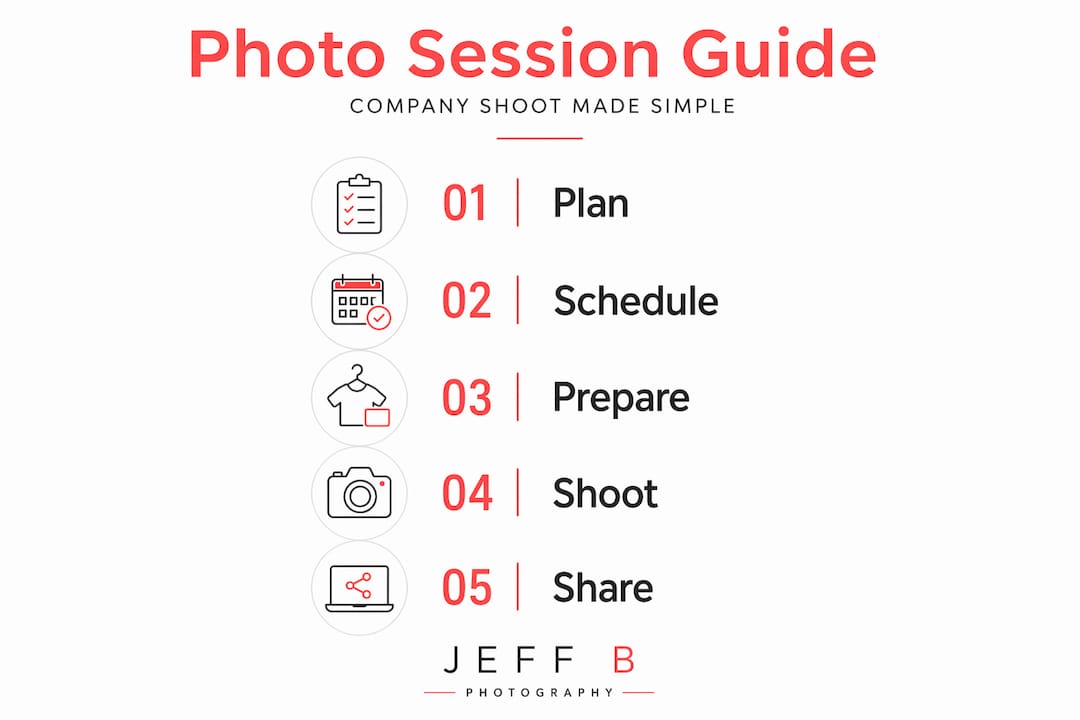
The biggest mistake I see is leaving planning too late. When you try to organise a business photo shoot in the week before it happens, you end up with scheduling conflicts, employees who haven’t thought about their wardrobe, and a rushed experience that shows in the final images. Preparation starts 4 to 6 weeks in advance, including clarifying purpose, selecting locations, scheduling 5 to 15 minute slots per person, and coordinating wardrobes.
Here is a practical planning sequence that works well for Calgary businesses of any size:
Define your purpose — Are you updating employee headshots, building a culture library, or refreshing your entire brand image? Clarity here shapes every decision that follows.
Book your photographer — Do this first, not last. Good photographers fill up quickly, especially for team sessions.
Select your location — In-office, studio, or outdoor? (More on this in the next section.)
Build your schedule — Allow 5 to 10 minutes per person for headshots, plus buffer time for setup, group shots, and late arrivals.
Send wardrobe guidelines — Give employees at least two weeks’ notice so they can prepare. Suggest solid colours, avoid busy patterns, and recommend layers for variety.
Send reminders — A reminder two days before reduces no-shows and last-minute scrambles.
Prepare the space — Clear clutter, arrange lighting areas, and designate a waiting zone so the session flows without interruption.
Reading up on preparing for professional headshots and best corporate headshot tips before your session gives both you and your team a real advantage going in.
Pro Tip: Create a simple one-page brief for employees covering what to wear, when to arrive, and what to expect. It takes 20 minutes to write and saves hours of back-and-forth questions on photo day.
Choosing the right location and setup for your photo session
Now that you know the planning essentials, let’s compare location options so you can choose the best setup for your session.
Location is one of the most consequential decisions in a corporate photography session, and it is often made too casually. In-office photos provide natural branded looks without weather risks; studio sessions offer full control over lighting and backgrounds; outdoor adds a relaxed tone but requires weather planning.
Location | Pros | Cons | Best for |
In-office | Branded environment, no travel, familiar to staff | Lighting can be inconsistent, space may be limited | Culture shots, team photos, most headshots |
Studio | Controlled lighting, clean backgrounds, professional feel | Less “real” atmosphere, travel required | Executive portraits, uniform headshots |
Outdoor | Natural light, relaxed and approachable tone | Weather-dependent, background inconsistency | Creative brands, casual culture imagery |
For most Calgary businesses, an in-office employee photo session hits the sweet spot. Your team is comfortable in their own environment, the space reflects your actual brand, and you avoid the logistical complexity of moving everyone off-site.
A few things to look for when scouting your in-office location:
Natural light sources like large windows (north-facing is ideal)
Clean, uncluttered backgrounds such as plain walls or branded signage
Enough space for a backdrop and lighting stand if your photographer brings equipment
A private waiting area so employees aren’t standing in a queue feeling self-conscious
Your business photoshoot guide can help you think through the specific setup that fits your office layout and brand personality.
Pro Tip: If your office has a branded reception wall or a distinctive architectural feature, use it. Backgrounds with subtle brand context add depth to your images without being distracting.
What to expect on company photo day: process and tips for a smooth session
With location decided, it’s helpful to understand what your employees will experience during the actual photo session day.
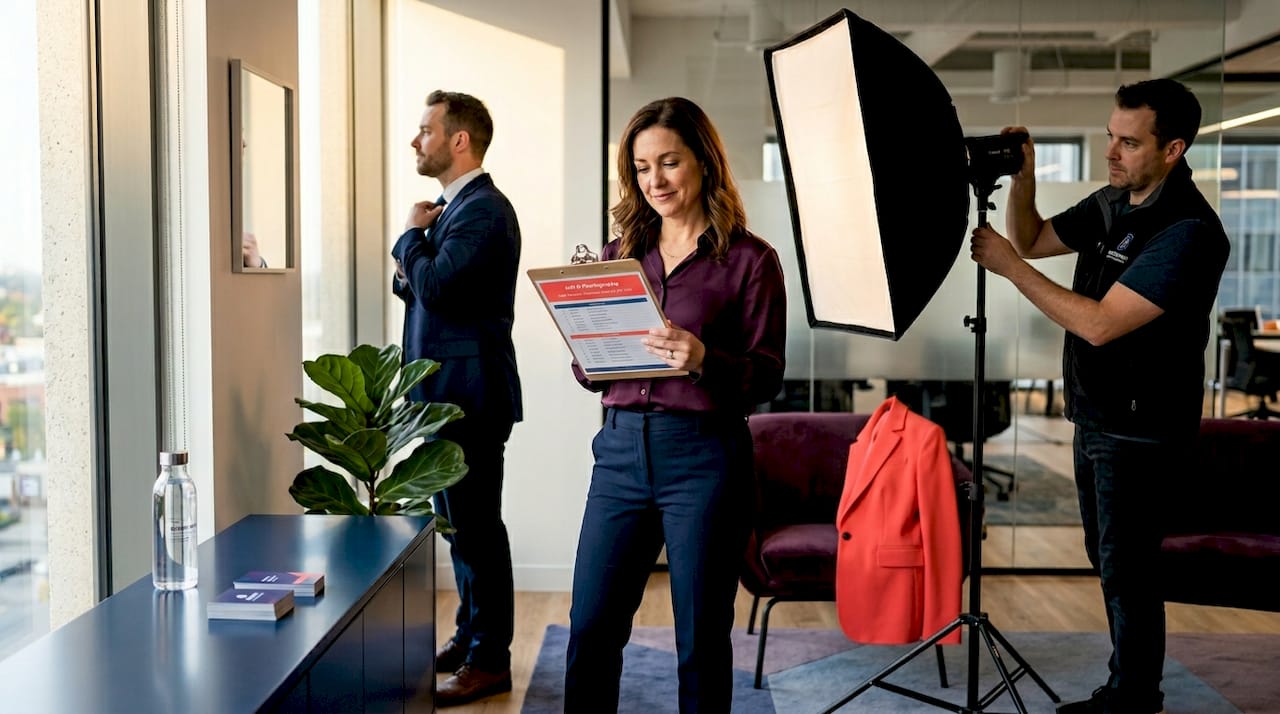
A well-run corporate headshot day should feel organised, efficient, and low-stress. The photographer guides natural posture and expressions, and consistent lighting and backgrounds create cohesion across the whole team. When employees know what to expect, they arrive calmer and photograph better. Nerves are the enemy of a great headshot, and preparation is the antidote.
Here is what a typical session day looks like from start to finish:
Setup (30 to 45 minutes before) — The photographer arrives early to arrange lighting, backdrop, and test shots. You should not need to manage this.
Individual sessions (5 to 10 minutes each) — Employees step in one at a time. A good photographer will guide posture, adjust expression, and take a variety of shots so there are genuine options to choose from.
Touch-up station — A small mirror, blotting sheets, and a lint roller nearby make a real difference. It sounds minor; employees appreciate it enormously.
Quick preview — Some photographers offer a brief on-screen preview so employees can flag any concerns before leaving. This builds confidence and reduces retake requests later.
Group photos — Schedule these at the start or end of the day when the full team is present, not mid-session when people have already dispersed.
The goal is to keep the workday moving. A well-scheduled taking professional headshots session should feel like a small, positive interruption rather than a half-day disruption.
Using your company photos effectively to enhance branding and recruitment
Once your photos are ready, let’s explore how to maximise their impact for your company brand and recruitment.
Photos sitting in a shared folder help no one. The return on a corporate photography session comes from active, consistent deployment across every platform where your company shows up. Corporate team photos shape how your company is seen long before a meeting or pitch begins, which means every touchpoint is an opportunity.
Here is where your new images should go immediately:
Website “About” and “Team” pages — Update these first. They are often the first place a prospect or candidate looks.
LinkedIn company page and individual profiles — Consistent headshots across your team’s LinkedIn profiles signal a unified, professional organisation.
Recruitment ads and job postings — Culture photos alongside job listings increase application rates by making the workplace feel real and appealing.
Press releases and media kits — High-resolution headshots of key spokespeople make your company look prepared and credible.
Proposals and pitch decks — Including team photos humanises your business and builds rapport before the first meeting.
Internal communications — Company newsletters, org charts, and onboarding materials feel more personal with real, current photos.
Thinking through team branding photo ideas before your session means you arrive with a deployment plan, not just a wish list. And if you want to go deeper on how photography fits into your overall visual identity, the creating brand assets framework is worth exploring alongside your session planning.
Why many company photo sessions fall short and how to avoid it
Here is an honest truth from years of photographing Calgary businesses: most sessions that produce disappointing results were not let down by the camera or the photographer. They were let down by a lack of clarity before the shoot ever started.
The most common failure point is not knowing what the photos are actually for. When the purpose is vague, everything else becomes vague too — the style, the tone, the wardrobe guidance, the location choice. Clarifying purpose early, whether that means formal headshots or approachable team images, prevents mismatched expectations and in-office setups provide natural branded looks without weather risks.
The second most common issue is wardrobe chaos. When employees show up in whatever they happened to wear that day, you end up with a collection of images that look like they were taken at five different companies. Solid colour guidelines, communicated early, cost nothing and make an enormous difference to the final result.
Poor scheduling is the third culprit. Sessions that try to rush 40 people through in two hours produce stressed employees and stiff expressions. Build in buffer time. Treat each person’s slot as their moment, not a box to tick.
I also see businesses choose outdoor locations because they sound appealing, then scramble when Calgary’s weather has other plans. In-office sessions eliminate that variable entirely and often produce images with more genuine brand character anyway.
Finally, the photographer relationship matters. The more context you share before the day — your brand colours, your website tone, examples of images you admire — the better your corporate headshots tips conversation becomes, and the closer the results land to what you actually envisioned. A great session is a collaboration, not a transaction.
Professional Calgary corporate headshots made easy
If you are ready to elevate your company image with a professional photo session, here is how Jeff B Photography can help make it effortless.
[
At Jeff B Photography, we specialise in corporate headshots and team sessions built specifically for Calgary businesses. The process is designed to be genuinely stress-free, from planning support and wardrobe guidance through to final image delivery. Every session produces consistent, polished results that work across your website, LinkedIn, proposals, and recruitment materials. Whether you have a team of five or fifty, we build a schedule that respects your workday and keeps disruption minimal. Explore our photo branding guide to see how professional imagery fits into your broader brand story, and browse our corporate headshots tips to arrive prepared and confident. Let’s make your team look as good as the work you do!
Frequently asked questions
How long does a typical company photo session take?
Most sessions take half a day to a full day, with individual headshots averaging 5 to 10 minutes per person, plus additional time for group photos and setup. Total time depends on team size and the variety of photo types included.
Should company photos be taken in-office or in a studio?
Both options work well depending on your brand tone and logistics. In-office photos feel natural and branded, while studio sessions offer controlled lighting and uniform backgrounds. For most Calgary businesses, in-office sessions are the more practical and brand-aligned choice.
How far in advance should I start planning a company photo session?
Planning should start four to six weeks before the session to allow ample preparation time for scheduling, wardrobe coordination, location scouting, and employee communication.
Can employees choose their own photo for professional use?
Yes, each employee can review their photos in a private gallery and select the image they feel best represents them before final retouching and delivery. This step significantly increases satisfaction with the final results.
Recommended


Comments